String Bending
Getting that singing tone or gutsy scream from a bend isn't just a matter of pushing up a string and hoping for the best.
The first thing to think about is exactly what you're going to move the string with. You might be thinking: your fingers, surely.
But there's more to it than that. Your fingers are the final point of contact with the string, but its really your wrist that should move the string.
Why use your wrist?
Well unlike some other techniques on the guitar, its not essential that you use your wrist. It is quite possible to bend strings well purely by flexing your fingers. However, consider the amount of finger joints that have to be involved, the amount of muscles that would have to work in perfect sync. Now consider locking your fingers and using the rotation of your wrist to move your fingers up, bending the string. One of the advantages of doing this is that you have a lot of control and speed built into the rotation of your wrist. Think about all the door knobs and car ignition keys you've turned in your life. Think about how many times you've carefully flexed all your fingers in unison. There's no contest, your wrist has been doing the very movement you need to use for years. So it makes sense to use that movement.
Another good reason to use your wrist rotation for bending is that its also one of (for most people the best) best methods of vibrato. Using your wrist to vibrato the strings if the method favoured by most professional guitarists (and for good reason). If you'd like to read more detail on this Click Here to read the vibrato article. So if you want to have vibrato at the top of your sustained bends (and this is what makes them sing), it makes sense to use your wrist for both the vibrato and the bend, it becomes an extension of the same thing. It is in fact extremely difficult to vibrato a bend without using wrist rotation. So if you haven't used your wrist to do the bend, its not going to be easy to suddenly employ it at the top of the bend. If you used your wrist to do the bend, then vibratoing it from there is a natural continuation of the same movement.
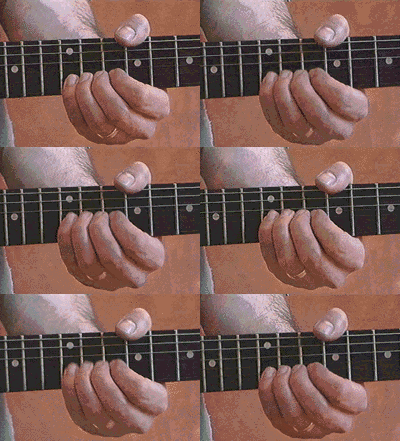
Your wrist also gives a you a lot of control over the "envelope" of the bend - more on this later.
How do you go about getting your wrist to move the string?
Imagine you're hanging from a window ledge buy your finger tips. You'd have to have your fingers curled and locked in position. You want to adopt this same position for bending a string (only without the tension necessary to support your weight!). Use as many fingers on the string as you can. For example if you are bending a string with your 4th finger, get at least your 2nd and 3rd fingers on the string bunched right up behind the 4th. Use your first finger to help too if its available.
Keep your thumb hooked over the top of the neck (the leverage this provides is important for both bending and vibrato so you'll need to switch from playing with your thumb on the back of the neck to having it hooked over the top, depending on what you are doing). Keep your fingers slightly curled, but not too curled and pointing towards your picking arm shoulder.
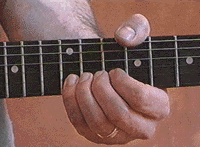
Now keep your fingers locked, and rotate your wrist so that your fingers bend the string up
If you lift your fingers slightly off the strings and rotate your wrist, you'll see that this gives you a huge amount of movement in terms of string bending. Its just a matter of keeping your fingers locked.
Once you have this technique well in hand its time to get accurate control of bending to various pitches. Subtle control of pitch (including microtones) is the hallmark of many a great player.
Wait before bending. You won't always want to do this, but as a general rule, unless you have a good reason not to, you should wait before you bend.
What do I mean by wait? After you pick a note but before you bending it, wait so that the note has a chance to sound at it's unbent pitch. This wait might last as long as the bend itself, or it might only last a fraction of a second, but its important that its there unless you have a definite reason to exclude it.
Why? For at least two reasons. One is that part of the idea of a bend is that you hear the pitch of one note move smoothly to the pitch of another note. Unless you actually get the chance to hear the original unbent note, you are missing part of the effect of bending a note.
A second reason is that unless its a really quick bend, bends usually sound best when they are round and smooth sounding. Typically when you hear a nice sounding bend, its got a round smooth movement to it - the player didn't just whack the thing up there, they put more into the bend than that. What they've done is control the speed of the bend. The usual way to do this is to start a bend slow, and speed it up as you near the target pitch. This gives it a round emotive sound.
A third reason is that if you don't wait at all after you pick the note before you bend, unless you are a very experienced player, you are likely to start bending the note just as (or just before) you pick. The effect this has is that the first sound the listener hears from this note is a slightly sharp note (out of tune) which moves up to a (hopefully) in tune note. The general effect is not good. It sounds far better to wait (at least a fraction of a second) before you bend, to establish the original pitch.
A fourth reason for waiting before you bend is that its much easier to hit your target pitch if you've heard the original pitch.
Once you've got the basics of the correct, or most efficient, ways to bend strings, its time to look in more detail at different types of bends.
There are four basic types of bend (with a lot of subtle variation on each).
1) Bend and sustain

Click the button.
To make to most of this type of bend, it helps to make it "round" sounding. The first step towards this is to wait before bending, even if this wait is only for a few tenths of a second. So you pick, wait, then bend. Start the bend slowly and speed up as you get near the target pitch.
2) Bend and stop at the top
Click the button.
This type of bend is one of the most common. The string should be stopped the instant you reach the target pitch. You should stop the string with the finger (that holds the pic if you use one) and or thumb, of your picking hand (or you can use the pick itself to stop the string). You don't stop the bend by releasing the note with your fretting hand only. The ability to stop the strings instantly in this way is an essential part of most modern (and old) styles of electric guitar playing.
3) Bend up and bring down
Click the button.
The exact timing of this type of bend can vary quit a bit depending on the context in which its used. If its part of a riff (which it very commonly is) its likely to be done quite quickly. If its done as a more significant, stand alone, part of a solo, its more likely to follow the slow to fast movement of the sustained bend. That is: pick, wait, bend starting slowly, speed up as you reach the target pitch, slow down again as you bring it back down to the original unbent pitch. Even if its done as part of a riff its almost always a good idea to wait a few tenths of a second after picking, before you bend it.
4) Prebend
Click the button
Here you silently bend the note before picking it. You then pick the already bent note, and bring it down to the unbent pitch.
All four of these basic types of bend are used frequently, so its important to get familiar with and adept at them all.
Remember that a sustained bend (by that I mean a bend where you reach the target pitch and sustain it), usually sounds best with vibrato on the sustained note (this is more often than not, true for unbent sustained notes as well).
Now lets look at pitch.
You can of course bend a string any amount, until it breaks, or bend as little as pulling it just slightly sharp. The most common types of bend though (and the ones you should be able to do) are the:
wholetone bend semitone bend three semitone bend (distance of a minor third)
Less common but worth experimenting with, are the four and five semitone bends ie: bending up a major 3rd or a 4th. Granted these are big bends and you may find them difficult at first (or impossible if you use heavy gage strings). However if you use a .009 gage string as your high E it is quite possible to bend up four and five semitones.
I recommend that you work on these extreme bends. The reason being, that if you can bend a string up five semitones, when you come to bend up a wholetone it will be so easy, that you'll be able to do it with that much more control.
You should work on these bends until you can do them all accurately. Its important to check that you are getting the bends to the right pitch by checking them against unbent notes at the target pitch. So for example, if you intend to bend up three semitones from a C to an Eb, play an unbent Eb before and after the bend to make sure you are getting the pitch accurately when you practice.
Once you can do all these bends accurately, the next stage is to be able to play more than one pitch within the same bend. So for example, you might bend up a wholetone, stay there a short time, and then while the note is still sustaining, bring the bend down a semitone.
Here is an example of just such a bend. The root here is A. The note C (a b3rd) is bent up a wholetone to D (a 4th), its then brought down and back up a semitone to C# (a Major 3rd), the root A is then played (unbent).
Click the button.
Finally, remember the following points:
1) For most bends: pick, then wait an instant before you bend, let to original unbent pitch establish itself before you move it.
2) For smooth round sounding or swooping bends, start a bend slow and speed up as you get nearer the target pitch.
3) Use your wrist to bend the string, this gives you more control than flexing your fingers, and it allows you to put vibrato at the top of bends.
4) Practice bending to various pitches: semitone, wholetone, three semitones (b3rd), four semitones (Maj 3rd) and five semitones (4th).
5) If you want to sustain a bend, if you put in some vibrato (using the wrist) it can really help the note sing.