Making your improvisations more interesting part one
Mark Wingfield looks at techniques for playing with the rhythm of the notes in your solos.
Playing with rhythm.
Most playing can be broken down into the the elements of 1) rhythm and 2) scale and note choice, melodic sense.
So we'll start off in this article by looking at rhythm and how you can expand your abilities with this, to greatly add to your ability to improvise and generally come up with ideas.
Rhythm is one of your most powerful tools for improvising. The ability to phrase well and inventively is largely to do with your ability to play with the rhythm of your notes.
There's a saying in some jazz circles that if your phrasing is good enough, the choice of notes is sometimes of secondary importance. I'm not sure I'd go along with this myself, but it does point out the importance phrasing plays in improvisation, and phrasing has an awful lot to do with rhythm.
So by expanding you're abilities to play with rhythmic ideas, be it rock, jazz, blues, or whatever style, that involves some improvisation, you will greatly enhance your tools for improvising.
Even if you are happy with your improvising ideas, you'll very likely find that an increased rhythmic facility will help your feel, even if you play the same things. If your facility with different rhythms is not that strong, you'll be having to try that little bit too hard, and this will take the edge off your feel.
So how does one go about working on control of rhythm and hence the ability to play around with it?
To begin with, I suggest you get a firm control of off beats and the ability to mix them fluently with on beats. I'm not talking about counting 1,2,3,4 to the bar and playing on the off beats. Like 1,&,2,&,3,&,4,&,etc... What I mean is the ability to switch in mid phrase from on to off the beat and back again fluently. You want to be able to switch from on to off the beat with complete freedom.
This is where the secret of a lot of rhythmic playing about lies.
Think of it like this: If you only ever play on the beat, its not exactly interesting rhythmically - nor if you just play off the beat. The interesting rhythms occur when you mix the on and off beats.
Try comparing it to strumming. If you strum a rhythm using bar chords, the normal way is to strum up and down to create the rhythm. So typically you would be strumming up and down and pressing and releasing (muting) the chord with your left hand to create the rhythm. If you only ever pressed chords on the down strums, or only ever on the up strums (try it), you'd end up with a very limited rhythmic approach. But by mixing pressing on up and down strums (on and off beats) the huge rich variety of rhythms we've come to expect, are generated.
So why haven't you been doing the same thing with your lead playing? Unless you can fluently switch from playing on the on beats to playing the off beats, you are very seriously limiting the rhythmic content of your lead playing. Considering the fact that music as a whole can be divided in to two very basic components: The rhythm and the notes, why leave one side of this undeveloped?
There is an excellent exercise for developing the essential ability to play with the on and off beats and hence the rhythm in you lead playing. This requires however that you use alternate picking.
Personally I favour alternate picking in general over sweep picking and this is why: Alternate picking is like up and down strumming in that it allows you to play about with rhythm and subtle timing and accenting that would be impossible with sweep picking. Having said that, there are some advantages in my opinion to sweep picking certain things, so combining the two would seem a reasonable solution. Alternate picking does take a lot more work to get fluent with however, so if you want to be able to improvise rhythmically, it might be an idea to put most of your time into the alternate picking, reserving sweeps for thee odd one note per string arpegeo passage.
A problem I come across with a lot of students is that they only sweep pick, they don't actually know how to alternate pick properly. And for the kind of rhythmic control I'm talking about, you really do need to be able to alternate pick properly and fluently (even if you sweep pick some things as well). As an example; one of the most common problems I find is that when going up or down a scale which has three notes per string, people alternate pick on each string, but they sweep across the strings - this is not alternate picking and will severely limit your control of rhythm and accenting.
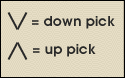
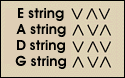
If you have three notes on a string in your scale shape, the first pick on each string should be in the opposite direction.
 |
 |
etc...
Notice above that the direction of the pick for the first note on each string is opposite to the first note on the string before. This is very important.
What I often see is people picking down, up, down on one string and then the same down, up down on the next string - where as it should be down, up, down on one string and up, down, up on the next. Don't underestimate the importance of this point!! Its not a detail, its the essence of alternate picking. Some people think they are doing this but are in fact not. I suggest you take a close look at your right hand to make sure you are alternate picking correctly before you try the rhythmic exercises I'll be suggesting.
Once you feel you have alternate picking sorted out and fairly fluent start on the following exercises.
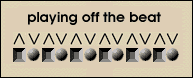
Put on some backing music or a beat of some sort, and play down a scale alternate picking every 8th or 16th note (depending on the speed of the beat you might play either 8th or 16th notes).
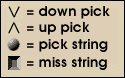
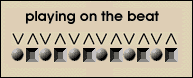
So you are playing and alternate picking every 8th or 16th note: next, switch to playing notes just on the down picks and miss the string with the up picks. This is VERY important: the fact that you still DO the up pick motion, but you simply miss the string with the pick. It is of course possible to create a similar effect by stopping alternate picking and simply switching to down picks with no up pic motion involved. I would recommend in the strongest possible terms that this is not the thing to do. If you abandon alternate picking, you will find it very hard to improvise rhythmically, very hard to control your accenting, and very hard to get a good rhythmic 'feel'.
>Once you've comfortable with playing notes only on the down picks (on the beat) and missing the string on the up picks (but still doing the up motion), the next thing is to switch to playing only the up picks. Here you still do the down pick motion, but you simply miss the string as you had been doing with the up picks in the previous exercise. You are now playing on all the off beats. Practice playing all the 8th or 16th notes and then switching to playing notes on all the up picks.
 |
 |
 |
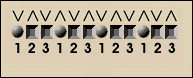
When you feel fluent with this, practice alternating picking using a pattern of three. So for each pick up or down, you count. You count in 3's: 1,2,3,1,2,3,1,2,3 etc... Then you simply play notes on the 1's and miss picking the 2's and 3's though still doing the picking motion of course. I can't emphasise enough the importance of keeping the alternate up and down pick motion going, even when you are missing a lot of the picks. This is the only way you will easily get interesting rhythmic changes and accenting to mix fluently and seamlessley into the rest of your playing.
You'll notice that as you count in 3's playing only the notes that fall on the ones, that the notes you play will alternate up, down, up, down etc... If this doesn't happen, you're doing something wrong. So reexamine your alternate picking.
So your picking should go like this:
 |
When this becomes easy, you should start to mix all three of these elements with 16th or 8th notes. So you mix 16th or 8th notes with down picks (missing the string with the up picks), then with up picks (missing the string with the down picks) and finally mixing in the counting three hitting the string on the one's. Does this sound complicated? Its difficult to explain without it sounding over complicated. In fact all I'm saying is that you combine all three of the exercises we've done so far.
After a while you'll find that the exercises above will become second nature. At this point, you'll find that your ability to play around with and hence improvise with the rhythm will be transformed.
Once you have this control, you can start stealing riffs from drummers and play them on the guitar. Percussionists are really worth listening to as well. You'll find that a lot of the rhythms drummers and percussionists (and programmers) play can be played on the guitar. Try thinking of the fact that a drummer has two hands and they do a lot of things by just playing back and forth between their hands. On the guitar, some of these things can easily be translated into alternate picking.
For example, lets take a basic drumming rudiment: the paradidle. If you play a paradidle with your hands it goes as follows:
R = right hand
L = left hand
R,L,R,R,L,R,L,L...
This could be transferred to the guitar by using two adjacent (or not adjacent) strings to replace the drummer's hands. So for example, where it says R above, you could fret and pick a note on the B string; where it says L above, you could fret and play a note on the E string. By moving the notes you fret around at different points in the rhythm, an amazing amount of rhythmic variety suddenly appears. I do suggest that you get to know how this rhythm sounds by tapping it with your hands before you attempt it on the guitar. I also think that a few lessons from a good drummer or percussionist will help any guitarist. Rather than learning how to play the drums, I would suggest that you get the teacher (or drummers friend) to show you the basic drumming rudiments and them progress onto how these fit together to produce various rhythms or rhythmic riffs. Also concentrate on learning things that you do with two hands rather than getting the feet involved.
Mark Wingfield