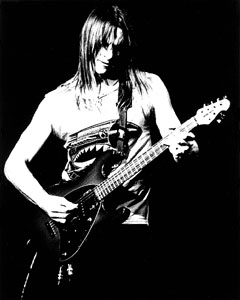
Steve Morse on Amps and Delays:
We start with a rundown on his current set up which uses two amps, one with the original guitar signal and the other with only the output a delay pedal.
Over to you Steve:
The delay pedal goes through a volume pedal, but if you send it back to the original effects loop in your amp, it means that your amp is being asked to translate the dry signal plus the delay. That's OK as long as the signal is clean, but when you use distortion or...in my case tons of distortion, you need everything in your favour to have some clarity to the sound, so that it doesn't sound like um...well...a bunch of noise.
One of the things that helps is to separate the effects, put the effects through a separate amp so that the effects are actually adding to the sound. Another thing this allows you to do, is when you're playing some fast passages to turn down the delay, so it doesn't confuse the sound. So you can clean it up by not using the delay during the fast parts, and then bringing it back in for the slow parts, there by implying that guitarists have brains. Some people think that guitarists have a real limited scope of understanding, but we're showing them gradually...that we deserve even to be in the mix sometimes.
During the less dense passages there'll be more delay, and when there's more notes they'll be less delay. I'll be kinda riding it like I would in the studio. When I'm mixing a record or something and you got a guitar solo and you're running with a little bit of delay, you ride it. When you're in a fast passage, you turn down the delay and you turn up the guitar a little bit; and when its slow or high notes, you can turn down the guitar signal a little but and turn up the delay, so that it floats.
Keeping the delay in a separate amp stops it from becoming too distorted and you can use the volume control on the guitar to fade in chords and things. Sometimes it takes a little bit of finesse to produce a result that just seems very natural.
Say, if there's a quiet moment in a tune...and it...it could happen (laughs). look down at the volume and think...hey...it could be done...change the volume. When its actually a moody moment you can use your guitar to paint a lot of different accompaniment, instead of just WANG OK another chord WANG.
With my solo gigs or the gigs I do with my trio, I use the synth all the time. Like I'll be playing a part, and then the second time it comes around I'll fade in the synth through another set of speakers, so it adds to the guitar. And so then people go "oh your playing to a tape right...I can't believe we paid money for this" (laughs). But its not the case, its just a synth coming through another set of speakers that's shadowing what I'm playing.
Steve Morse