Creating a musical toolkit Part 4
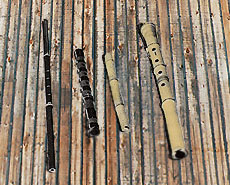
SHAKUHACHI
In this artice Aric Rubin and Mark Wingfield have a look at the amazing sounds of the Shakuhaci and how you can use these influences in your own playing.
There are countless styles of music, being played all over the globe, which many of us may know very little about.
However, there has been a major interest in recent years in music from around the world, and in using samples of this music.
Musicians and composers throughout the ages have found insparation in music from other parts of the world. There's a vast, rich source of musical ideas accross the globe to draw from.
As an example we've decided to look at Japanese Shakuhachi music. The Shakuhachi, is a long wooden flute, held vertically. When played well, it produces a very characteristic sound. Anyone with a modern keyboard is familiar with the synth/sampled version of this instrument, since its present on most synths now. The synth sounds are a sugary shadow of the real thing of course.
There are many types of Japanese music, but within this, the Shakuhachi forms its own distinctive musical area.
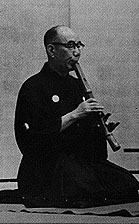
Shakuhachi playing is often full of sharp releases of breath and huge dynamic variation, though it can also be very subtle.
One of the most characteristic qualities of Shakuhachi playing is the common occurrence of a 'grace note' that almost immediately precedes the main note. In other words if a Shakuhachi player hits a note, its likely to be heard just after a very quick higher or lower note. Its a bit akin to singing a note and letting your voice quickly break from falsetto into the actual note or the other way round. In the case of the Shakuhachi, this quick change in pitch gives an emotive force to the sound.
Shakuhachi music, especially the solo flute literature, reflects many of the strongest characteristics of traditional Japanese music.
A skilled shakuhachi player can bend pitches up or down by as much as a major third (for example; from C to E). This allows for a great deal of subtle shading of pitch. Listen to the first example.
But the vocabulary also includes glisses

This sample demonstates combined overblowing and gliss. It also demonstrates the extreme breathiness of tone common to shakuhachi music.
Advanced shakuhachi players also use techniques which, though traditional and several hundred years old in Japan, have only been recently explored in the European/America flute tradition. These extended techniques include:
This array of pitch related devices reflect a seemingly simple vocabulary which creates an extremely elegant range.
A longer peice of Shaku playing, combining various ellements.
As a musician, you may try incorporating some of these kinds of techniques into your playing or composing. In fact, things like bent notes or overblowing (using distortion) may already be a component of your music. But hearing how these techniques get used in other music can really expand our possibilities.
Obviously one thing you could do would be to sample some shakuhachi playing and put it into a piece of music. Another approach might be to try and play 'like a shakuhachi' with some other sound. This would of course require a fair but of listening to shakuhachi music. Another idea might be to sample an aggressive outburst of shakuhachi and use that in a percussive way.
The really interesting thing, is to spend some time with this music and you'll probably hear and find all sorts of hitherto unknown new ideas.
Aric Rubin and Mark Wingfield